AI Agent for Vendor Performance Management (2026)
Quick summary: Monday, the receiving table and the email thread. An agent scores health, problems, and next actions. Demo on-time at 81% is a fixture. PO changes stay HITL.
Key Takeaways
- Demo on-time at 81% is a fixture
- This is series part 26 of the 2026 field guide — vendor ops in 15 automations and back-office vendor communication
- B2B sales agents (outbound quotes) are a different series post — do not reuse this prompt for them
- Demo fixture on watch after an 81% on-time window is a sample, not a client
- Automate first If ERP already emails OTIF < 90% to a buyer who updates the QBR, keep that

Table of Contents
Monday, vendor email threads are where qty and ETA change while the OMS still shows last month’s promise. OTIF, fill rate, defects, returns, price drift, lead-time slip — buyers already have the data, split across five exports. The job is a scorecard with a next action, not a chat that “sounds senior.”
The job. Join receipts, quality, price history, and PO promises into health, problems, causes, and recommended actions.
This week. Produce the scorecard from named tools. Draft vendor email. Do not send it. Do not cancel a PO.
A person still signs. PO change, preferred-vendor switch, and vendor email. One bad week is watch — not drop.
Skip it when ERP already scores OTIF and fill rate and a buyer already acts on a monthly QBR. Also skip it if you cannot name who may change a PO or switch preferred vendor. Skip it when the only input is a weekly CSV in email and nobody needs a join across systems.
This is series part 26 of the 2026 field guide — vendor ops in 15 automations and back-office vendor communication. PO send stays on the purchase order agent. B2B sales agents (outbound quotes) are a different series post — do not reuse this prompt for them. Demo fixture VENDOR-KNIT-01 on watch after an 81% on-time window is a sample, not a client. We are not publishing an OTIF engagement from a FactualMinds supplier program.
Inbound supply health is not outbound quoting. A vendor scorecard that can also “negotiate” is a write surface you did not review.
Copy the scorecard — Open
vendor-health-scorecard.md. Every problem needsevidence_tool. Ship gates:monday-checklist.md. Folder:ecommerce-ai-agents-series/.
Our take: output is Vendor Health → Problems → Root Causes → Recommended Actions. PO change is HITL. Trade-off: a delayed ASN sits in a queue instead of an auto-cancel. You also do not fire a supplier on a one-week shock.
Automate first
If ERP already emails OTIF < 90% to a buyer who updates the QBR, keep that. Add an agent when receipts, quality codes, price history, and PO promises disagree. Rules can flag a threshold. The agent joins systems and drafts. It does not rewrite the PO.
A weekly CSV in email is a workflow. An agent is for the week a fill-rate dip and a price change land in different systems and someone has to write a next step.
Scorecard contract
From the artifact:
| Metric | Watch-out |
|---|---|
| On-time delivery | Carrier/port delay ≠ vendor fault until confirmed |
| Fill rate | Partial ASN vs short-ship |
| Defects | WMS damage ≠ supplier defect |
| Returns | Size/fit is merch, not vendor |
| Pricing vs last PO | Promo cost vs list |
| Lead time vs promise | Email change not in ERP |
| Purchase history | Volume concentration |
Root causes without a tool stay unconfirmed.
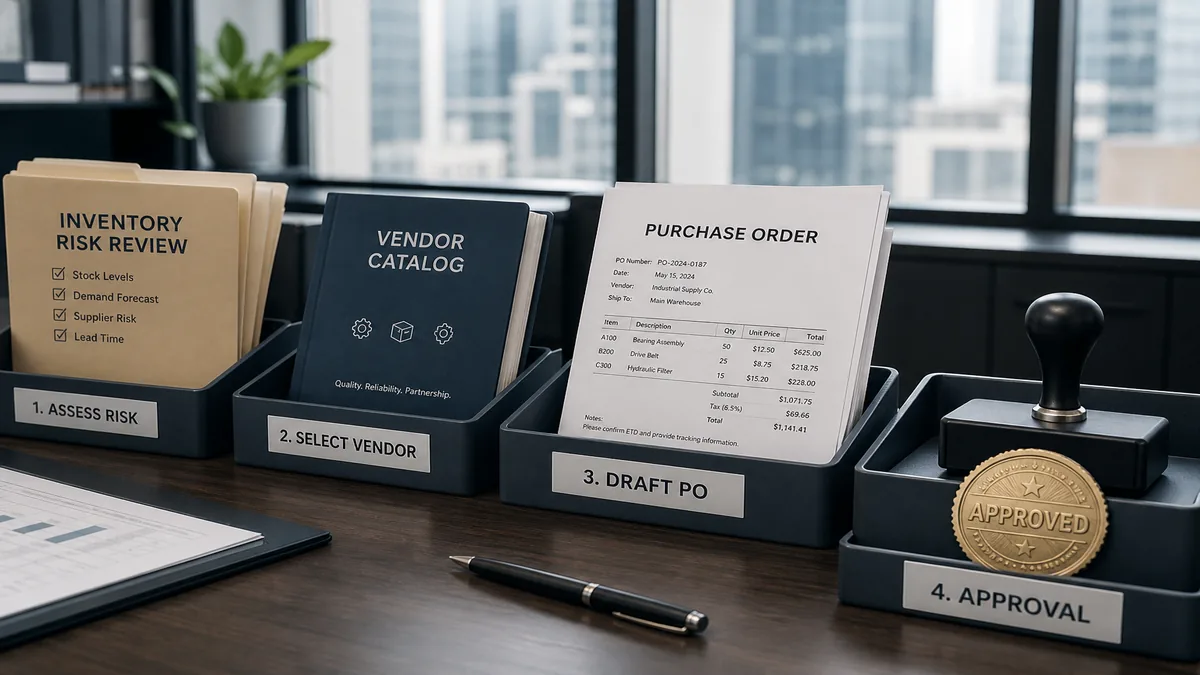
flowchart TD
  VendorMetrics[Vendor Metrics]
  Health[Vendor Health]
  Problems[Problems]
  RootCauses[Root Causes]
  Actions[Recommended Actions]
  HITL[PO Change HITL]
  VendorMetrics --> Health
  Health --> Problems
  Problems --> RootCauses
  RootCauses --> Actions
  Actions --> HITL
Health labels (ok / watch / at_risk) are your thresholds in the scorecard, not model confidence. at_risk still does not send mail or cancel a PO. It queues a buyer review with the tool rows attached (session id + Gateway spans), same HITL pattern as back-office vendor email.
Fill rate and on-time are different problems. A vendor can be on time and short-ship. A vendor can fill 100% two weeks late. Do not collapse them into one “score” the model invented.
Production shape
Bedrock = model. Harness or Runtime = host. Gateway + Cedar. Browser off (no scraping the supplier’s track-and-trace page). Next.js can hold the HITL queue. Strands is the framework if you need specialists — not the landing zone.
| Piece | Role |
|---|---|
| Gateway | OTIF, fill, defects, quality returns, price history, lead time, PO history; draftVendorEmail |
| Policy | DENY sendVendorEmail, cancelPurchaseOrder, switchPreferredVendor except buyer/admin |
| Identity | Shopper JWT never invokes this specialist |
| Memory | Vendor-id scoped; no bank accounts or personal emails in dumps |
No native Shopify connector.
{
  "vendor_id": "VENDOR-KNIT-01",
  "health": "watch",
  "do_not": ["sendVendorEmail", "cancelPurchaseOrder", "switchPreferredVendor"]
}
Vendor concentration (one supplier = most of a category’s receipts) is a risk row, not a drop. Recommend a backup-vendor review. Switching preferred vendor is HITL and should cite getVendorPoHistory. Draft emails must not invent chargebacks or new unit costs — same rule as back-office vendor communication.
What broke
What broke — Sample scorecard treated a one-week OTIF dip as
drop vendorand drafted a PO cancel. The calendar tool had a named port delay; fill rate was still in policy. Policy wasLOG_ONLY; a send tool was already on the OpenAPI. Detection: eval required a second window before dual-source; Gateway showedcancelPurchaseOrderafter a singlegetVendorOtif. Fix: one window = watch; PO change HITL; remove send until Cedar ENFORCE; do not invent penalty clauses. Lesson: vendor performance is a time series. A single shock is not a sourcing strategy.
What to Do This Week
- List vendor metrics you already trust in ERP. If a QBR already closes the loop, do not add an agent this week.
- Clone
vendor-health-scorecard.md. Name who may change a PO. - Read tools: OTIF, fill, defects, quality returns, price, lead time, PO history.
- Harness or Runtime; Gateway; Policy
LOG_ONLY. Browser off. - Prove DENY:
sendVendorEmail,cancelPurchaseOrderon a non-buyer token. - Eval: one-week port delay must not recommend drop-vendor.
- Model cost on the AgentCore pricing calculator. Contact us, Bedrock, retail / eCommerce.
Full ship list: monday-checklist.md.
If You Only Do One Thing
Treat a single window as watch. Dual-source, PO cancel, and vendor email stay HITL with tool evidence — never a one-week OTIF dip.
For your technical lead
On June 17, 2026, AgentCore Harness reached general availability (What’s New). Agents Classic is in maintenance for new customers after July 30, 2026. Skip Classic for net-new vendor ops (lifecycle).
First-party signals we reuse (not eCommerce outcomes) — Gateway server-side tools cut median tool round-trip ~180 ms → ~95 ms on a B2B CRM assistant (12 tools, ~8k turns/day) — Gateway post. Platform TCO silhouette: support-style AgentCore at 50K sessions/mo ~$791/mo platform + model (decision guide). Model your mix on the AgentCore pricing calculator.
What This Post Doesn’t Cover
- Legal contracts, chargebacks, or penalty language the model must not invent.
- Measured OTIF from a FactualMinds supplier program. We have no published agent case study that claims fill rate improved by a percentage.
- B2B storefront sales agents (outbound).
- EDI 856/810 field maps.
- AgentCore Browser on supplier portals.
- Classic Agents.
- Using shopper-facing support prompts for vendor ops.
FAQ
When should we NOT use an AI agent for vendor performance?
Skip it when ERP already scores OTIF and fill rate and a buyer already acts on a monthly QBR. The agent is for joining receipts, quality returns, price history, and PO promises when those live in different systems. Also skip it if you cannot name who may change a PO or switch preferred vendor.
What could go wrong if we drop a vendor from one bad week?
A port delay looks like supplier failure. You dual-source, lose volume pricing, and still miss the inbound that was never the vendor’s fault. One window is watch. Dual-source needs a second window or a named capacity constraint in a tool — then HITL.
What could go wrong if the agent auto-changes POs or emails vendors?
Qty and ETA change in a thread the OMS never sees, or a penalty clause the model invented. Draft email; send HITL. PO change is the same gate as create. Cedar DENY sendVendorEmail and cancelPurchaseOrder for tokens that are not associate/admin/buyer.
Are quality returns the same as vendor defects?
No. Fit and size returns are merchandising. WMS damage can be warehouse. Only receipt defects and quality codes your QA team owns should hit the vendor score. The scorecard fails eval if it blames the supplier from a generic refund rate.
Should this run on Harness or Runtime?
Harness fits a scheduled scorecard with read tools and draft actions. Use Runtime plus Strands if purchasing and vendor ops are separate specialists and must not share PO writes. Net-new builds should not use Agents Classic after July 30, 2026.
Is there a native Shopify AgentCore vendor connector?
No. Vendor, ASN, and receipt APIs are your Gateway OpenAPI or MCP targets. Shopify, Magento, and custom ERP look the same at that boundary.
AWS Cloud Architect & AI Expert
AWS-certified cloud architect and AI expert with deep expertise in cloud migrations, cost optimization, and generative AI on AWS.